The shrinking world
Around the World in Eighty DaysThe shrinking world is the novel’s defining modern condition: railways and steamships make a journey around the globe imaginable within a fixed span of eighty days, turning distance into a problem of schedules, connections, and speed. Yet the route repeatedly exposes the difference between a world that can be crossed quickly in theory and one whose transport systems remain incomplete, vulnerable, and unevenly accessible. The idea is both the wager’s premise and the pressure that makes its apparent precision precarious.
The wager and the new measure of distance
The idea enters as a debate at the Reform Club. When Ralph observes that the world was once big enough for a bank robber to disappear, Phileas Fogg replies that it was once. Asked whether the world has grown smaller, Ralph argues that a person can now circle it ten times faster than a century before. That speed, he suggests, makes the search for a thief more likely to succeed; another club member counters that the same speed could help the thief escape. The exchange makes technological progress double-edged: faster movement improves pursuit but also evasion.
The conversation becomes a practical calculation when John Sullivan points out that the newly opened railway section between Rothal and Allahabad brings the proposed circuit down to eighty days. Phileas Fogg corrects Stuart’s estimate of three months with that exact figure, treating the globe not as an immeasurable expanse but as a sequence of timed legs. The route depends on combining rail and steamship travel, and its promise rests on coordinating departures and arrivals across great distances. The world seems smaller because timetables can now join places that once required much longer journeys, not because the places themselves have moved closer.
The Royal Geographical Society’s published objection gives the wager’s optimism a countervoice. Its argument is logistical: trains may break down, leave the line, or collide; snow and bad weather may block travel; winter winds and fog may delay steamers. Even a single missed connection could force a wait for the next vessel and destroy the schedule. The dispute is therefore not simply whether modern travel is fast. It is whether speed can be relied upon across an entire chain of separate systems, each exposed to interruption.
Infrastructure, scale, and uneven access
The account of India places this new mobility against a vast geography and a history of political change. It describes a region of roughly 1.4 million square miles and a population of 180 million, while distinguishing the smaller territory directly governed by the British Crown from areas outside its authority. It also notes the transfer of control from the East India Company to the Crown. Against that scale, the railway appears as a powerful reorganization of movement: fast steamers serve the Indus and Ganges, while a railway crosses the peninsula between Bombay and Calcutta in three days.
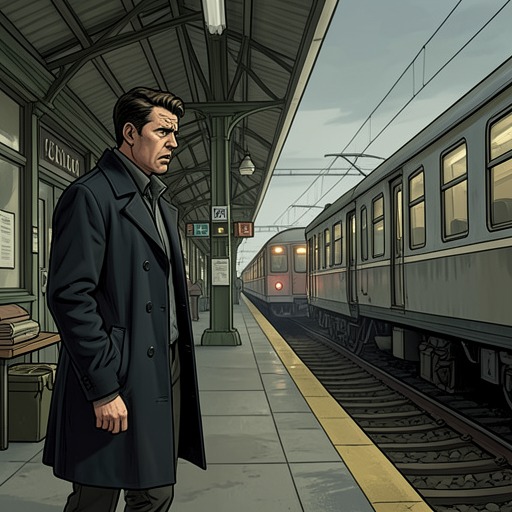
That line is not a straight passage. Its route turns through named towns and regions, and its deviations make the journey more than a simple measure between two points. More decisively, the apparent network is unfinished. At Kholby, passengers learn that roughly fifty miles of railway remain to be laid before Allahabad. The gap interrupts a journey whose promised speed depends on continuous connection. Modern infrastructure compresses distance where it exists, but the missing section makes clear that the compression is neither complete nor uniform.
The same contrast appears in Fogg’s conduct at Bombay. After leaving the steamer, he gives Passepartout errands, insists that his servant be at the station by eight, and goes to the passport office with his regular, clocklike step. He declines to see the city’s landmarks, including its public buildings, markets, religious sites, and the pagoda on Malabar Hill, then proceeds to the railway station for dinner. For him, the city is principally a point of transfer within a larger itinerary. The itinerary shortens the world by subordinating local time and sightseeing to onward movement.
Speed tested by weather and interruption
The novel does not present speed as a frictionless triumph. On the Red Sea, the Mongolia rolls heavily when winds come from either coast, and the rough passage silences the ship’s music and dancing. Nevertheless, the vessel continues toward the Strait of Bab-el-Mandeb without slowing. Fogg does not outwardly watch the weather or display anxiety; he keeps to his meals and games of whist. The scene contrasts the physical disturbance of the voyage with the steady forward movement on which the wager depends.
Other interruptions expose how much a traveler’s progress depends on available routes and vehicles. In Hong Kong, after three hours searching the docks for a vessel bound for Yokohama, Fogg remains determined to find passage, even considering Macao. The effort suggests that a destination may belong to the global network in principle while a usable departure is not immediately available. At Kholby, the railway gap makes the same point more starkly: a timetable can promise speed only across infrastructure that has actually been completed.
Measuring progress across the globe
The halfway point gives the shrinking world its clearest numerical expression. On 23 November, the General Grant crosses the 180th meridian, placing the travelers at London’s antipodes. Fogg has used fifty-two of the eighty days, with twenty-eight remaining. Yet halfway by longitude is not halfway by the actual route: the journey has already covered two-thirds of its full distance because earlier legs required long circuits. A direct course along London’s latitude would have amounted to about twelve thousand miles, but the irregular routes require approximately twenty-six thousand; by this date, the travelers have covered seventeen thousand five hundred.
That distinction between a line on a globe and the routes transportation allows gives the novel’s progress a concrete measure. The travelers are far from home but no longer facing the same obstacles: the course ahead is described as straight, and Fix is no longer there to impede them. Later, after the train journey is interrupted by the Sioux attack, Fogg is told that he is twenty hours behind. To reach New York in time for the steamer, he must regain eight hours, and the proposed solution is a sail sledge. The improvised vehicle shows that the pursuit of speed can require invention beyond the regular railway timetable.
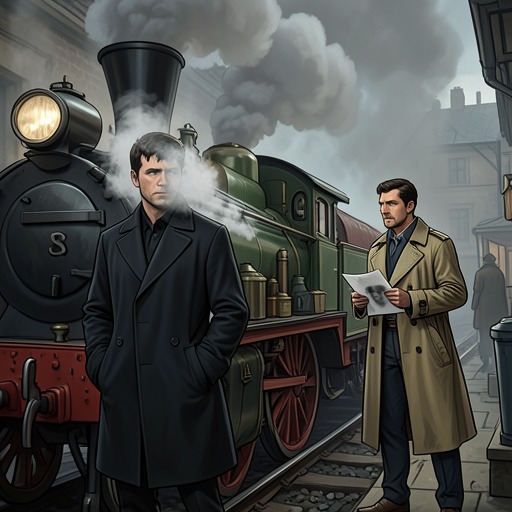
At Omaha, the party reaches the terminus of the Pacific Railroad proper, where a train connects with the Chicago and Rock Island Railroad. They have no time to see the town before boarding. That transfer makes the shrinking world a lived sequence of stations, vehicles, and hurried changes rather than an abstract claim about distance. The journey’s speed is real, but it is assembled from links that must meet—and sometimes from exceptional measures that carry travelers across the gaps.